



Vibe Coding App Development: The Complete 2026 Guide to Building Apps With AI
Vibe coding app development is the practice of building working software by describing what you want in plain English while an AI coding assistant generates, refactors and debugs the code. Developers guide the AI through prompts, review the output, and ship faster. It blends prompt engineering with real programming fundamentals, and it is now a mainstream skill across Indian product teams and startups.
★★★★★ 4.9/5 rated by 1329+ students · Google Verified
Table of Contents
Introduction
Something quietly changed in how software gets built. Five years ago, turning an idea into a working application meant weeks of boilerplate and configuration. Today a developer describes a feature in a sentence, watches an AI assistant scaffold it, then spends their real energy on architecture, edge cases and user experience. That shift has a name, and vibe coding app development is what the industry settled on calling it.
This guide answers what students keep asking me in class: what is this, is it real work, does it pay, and what do I need to learn? Vibe coding is neither a shortcut nor a gimmick. It is a workflow change that rewards people who understand software and punishes people who do not. If you want structured, mentor-led training, our Vibe Coding Course In Hyderabad is built around building real apps rather than watching slides.
Stack Overflow's most recent global developer survey found that 84% of developers now use or plan to use AI tools in their workflow, up from 76% a year earlier. Indian enterprise demand is climbing just as fast, which is why so many working engineers in Hyderabad are rebuilding their skill stack around AI-assisted development.
Vibe Coding App Development
What is Vibe Coding App Development?
Vibe coding app development is a workflow in which you state what an application should do in plain English, and an AI model writes the code that does it. Instead of typing every line, you describe the outcome: "build a signup form with email validation, store users in Postgres, and return a JWT on success." The assistant writes it. You read it, test it, correct it, and move to the next block.
The word "vibe" causes some confusion. It does not mean guessing. It means working at the level of intent rather than syntax, keeping momentum instead of stopping to look up how a particular API is spelled. For the concept from first principles, our breakdown of what vibe coding actually is covers the origin of the term and the misconceptions around it.
A typical session looks like this. You describe the product and its data model, ask the assistant to scaffold the project, then iterate feature by feature, running the code after each step. When something breaks, you paste the error and the file back in for a diagnosis. When the AI writes something inefficient or insecure, you catch it, because you know what good code looks like.
That last sentence is the whole discipline. The developer is still the engineer. The AI is a fast, literal junior that has read every documentation page ever published but has no idea what your business needs. Vibe coding is the practice of managing that relationship productively.
What separates vibe coding from just using autocomplete
Inline autocomplete suggests the next few tokens. Vibe coding operates at the feature level, sometimes the whole application. The unit of work is a described outcome, not a line. That changes how you plan, break down tasks and review, and it is why prompt quality matters. Our library of practical vibe coding prompts shows the difference between a vague instruction and one that produces production-ready output on the first attempt.
How AI is Transforming App Development Through Vibe Coding
The transformation is not limited to writing code. It touches every stage of the application lifecycle, and understanding each stage is what separates a hobbyist from someone employable.
Natural language programming
The interface to the machine has changed. You specify behaviour in English and the translation to JavaScript, Python or TypeScript happens automatically. This lowers the barrier for beginners but raises the ceiling for experienced engineers, who can express complex architectural intent in a paragraph and get a working skeleton back in seconds.
AI code generation
Modern assistants generate complete components, API routes, database schemas and test suites. Quality depends almost entirely on context. Give the model your file structure, naming conventions and constraints, and the output fits your codebase. Give it a one-line request with no context, and you get generic code you will rewrite anyway.
Debugging assistance
This is where AI earns its keep daily. Paste a stack trace, get a hypothesis. The catch is real: Stack Overflow's data shows 66% of developers say AI output is "almost right but not quite," and 45% report debugging it takes longer than expected. You must read code critically, or the time saved writing gets spent hunting a subtle bug. This is why we teach fundamentals alongside AI tooling in every hands-on Vibe Coding Course In Hyderabad batch.
Testing and deployment
AI is very good at generating unit tests, mock data, CI configuration and deployment scripts. These are high-boilerplate, low-creativity tasks where automation is a clean win, and teams that adopt AI here often see the biggest measurable productivity gain.
Why Vibe Coding App Development is Growing Rapidly
These are the causes driving decisions in Indian engineering teams.
- Faster development. Prototypes that took two weeks now take two days. For startups validating an idea, that is the difference between shipping and running out of runway.
- Reduced coding effort. Boilerplate, CRUD endpoints, form validation and config files eat a large share of a developer's week. Automating them frees attention for work that needs judgement.
- Lower project costs. A smaller team delivers the same scope, which changes the economics of every fixed-price proposal.
- Improved productivity. Just over half of surveyed developers report a positive productivity effect from AI tools, concentrated among those who use them well.
- Better collaboration. A well-written prompt is readable by designers, product managers and QA, so requirements and implementation converge.
- AI-assisted workflows. Code review, documentation, migration and refactoring all have AI-assisted paths now, so the workflow is changing end to end.
If you want the trade-offs side by side, our analysis of vibe coding versus traditional coding covers where the AI-first approach wins and where hand-written engineering still holds the advantage.
Career Opportunities in Vibe Coding App Development
Job titles are still settling, but these roles are already being hired across India.
- AI Application Developer — builds user-facing products on AI models and AI-assisted workflows. The most common entry point.
- Full Stack AI Developer — owns frontend, backend and AI integration. In high demand because few candidates cover all three.
- AI Software Engineer — a broader engineering role where AI tooling is assumed rather than special.
- Prompt Engineer — designs and maintains the prompt layer for production systems, one of India's fastest-growing specialisations.
- Low-Code Developer — combines platform tooling with AI generation to deliver internal business apps quickly.
- No-Code AI Builder — assembles products with minimal hand-written code, common in marketing and ops tooling.
- AI Product Developer — translates product requirements into buildable AI-assisted specs.
- Startup Founder — technical founders can now build a credible MVP alone.
- Freelance AI Developer — delivers client apps at speeds that were not commercially viable before.
For a fuller map of where these roles lead over five years, read our guide to career opportunities after learning vibe coding, which covers progression paths rather than just entry points.
Industries Using Vibe Coding for App Development
Adoption is broader than most people expect, and not limited to product startups.
- IT Services — the largest adopter in India, driven by delivery-cost pressure on fixed-bid projects.
- Healthcare — patient portals, appointment systems and internal clinical tools under compliance review.
- Finance — dashboards, reconciliation tooling and customer apps, with heavy human review.
- Education — learning platforms, assessment engines and content tooling.
- Retail — inventory apps, billing systems and store-level tooling.
- Manufacturing — shop-floor tracking, quality logging and maintenance scheduling apps.
- Logistics — route planning interfaces, driver apps and shipment tracking dashboards.
- E-commerce — storefronts, recommendation surfaces and seller-side tooling.
- SaaS — the fastest movers, since their entire product is software.
- Government — citizen service portals and departmental applications, on longer procurement cycles.
Top Companies Using AI-Powered App Development
Large technology organisations have moved from experimentation to standard practice. Microsoft, Google, OpenAI, Amazon, Meta, IBM, Salesforce, Shopify, Adobe and ServiceNow all build AI assistance into their internal engineering workflows, and several ship developer-facing AI products. Their India-based Global Capability Centres are among the most active hirers for AI-assisted engineering roles, with senior AI and MLOps compensation reportedly reaching the ₹58–60 LPA band.
What matters for a job seeker is the pattern behind the logo list: these companies are not hiring people to use AI tools. They are hiring engineers who use AI tools well. The engineering bar has not dropped, which is exactly how we sequence our Vibe Coding Course In Hyderabad training: fundamentals first, AI tooling layered on top.
Roles and Responsibilities in Vibe Coding App Development
Take a vibe coding role tomorrow and this is roughly your week.
- Prompt engineering — writing specifications precise enough to get usable output in one or two attempts.
- AI-assisted coding — directing generation and stitching the pieces into a coherent codebase.
- Debugging AI-generated code — the single most underestimated responsibility in the role.
- UI development — building interfaces in a framework such as React, then refining states and accessibility by hand.
- Backend integration — wiring APIs, authentication and data layers together correctly.
- API development — designing endpoints, contracts and error handling other teams can rely on.
- Testing — writing and reviewing tests, especially for code you did not personally type.
- Deployment — shipping to cloud infrastructure with sane environments and rollback paths.
- Performance optimisation — profiling and fixing the inefficient patterns AI models reach for by default.
- Security implementation — input validation, secrets handling and dependency hygiene, which AI rarely gets right unprompted.
Salary of Vibe Coding App Developers
Salary is the question I get most often, so here are ranges based on current Indian market reporting rather than aspirational numbers, covering AI-assisted development roles across product companies, GCCs and services firms in 2026.
| Experience | Average Salary (India) | Typical Range |
| Fresher (0–2 Years) | ₹5–8 LPA | ₹4–12 LPA with strong project portfolio |
| Mid-Level (3–5 Years) | ₹10–15 LPA | ₹9–18 LPA |
| Senior (6–10 Years) | ₹18–30 LPA | ₹18–35 LPA |
| Lead / Architect (10+ Years) | ₹30–50 LPA | ₹25–60 LPA at GCCs and product firms |
Two things move these numbers more than experience. The first is company type: the gap between IT services and product company pay at equivalent experience is frequently 60–150%. The second is demonstrable work — candidates with three deployed applications negotiate better than candidates with certificates and no repository. For a city-wise breakdown, see our analysis of salary after learning vibe coding.
Vibe Coding App Development Opportunities in Hyderabad
Because most of the students I teach are based here, Hyderabad deserves its own answer rather than a national average. The city is now India's fastest-growing Global Capability Centre destination, recently outpacing Bengaluru in new setups, hosting more than 400 GCCs and over 300,000 professionals across HITEC City, Gachibowli and the Financial District.
Those centres have shifted from back-office support to real engineering work in AI, cloud, GenAI and analytics, and demand sits in exactly the roles this article describes: AI and ML engineers, GenAI specialists, cloud architects and MLOps. Reporting puts Hyderabad GCC median salaries roughly 25–30% above traditional IT services, with niche AI and cloud skills commanding 20–40% premiums.
The constraint is supply, not demand. Campus intake has contracted even as requirement volumes grow, and Hyderabad is named among the cities where that entry-level gap bites hardest. For a working professional or recent graduate, that gap is the opening. A structured, project-based weekend Vibe Coding Course In Hyderabad lets you close it without leaving your job, while local classroom access puts you alongside people interviewing at the same companies you are targeting.
Essential Skills Required for Vibe Coding App Development
This is the part people want to skip, and the part that decides whether you get hired. AI removes typing effort, not the need to understand what you build.
Foundation layer
Start with JavaScript fundamentals alongside HTML and CSS. You need not memorise every method, but you must read code fluently, because reading is now most of the job. TypeScript follows quickly, since almost every serious AI-generated codebase uses it.
Framework layer
On the frontend, React remains the default target for AI code generation, with Next.js layered on for routing and rendering. On the backend, Node.js and Python cover most real projects, and Python has become the default choice for anything touching AI.
Data and integration layer
Learn SQL properly, then a hosted database such as Firebase or Supabase. Understand REST APIs, request/response cycles and authentication. This is where AI-generated applications most often break in production, because the model happily writes a query that works on ten rows and collapses on ten thousand.
Engineering discipline layer
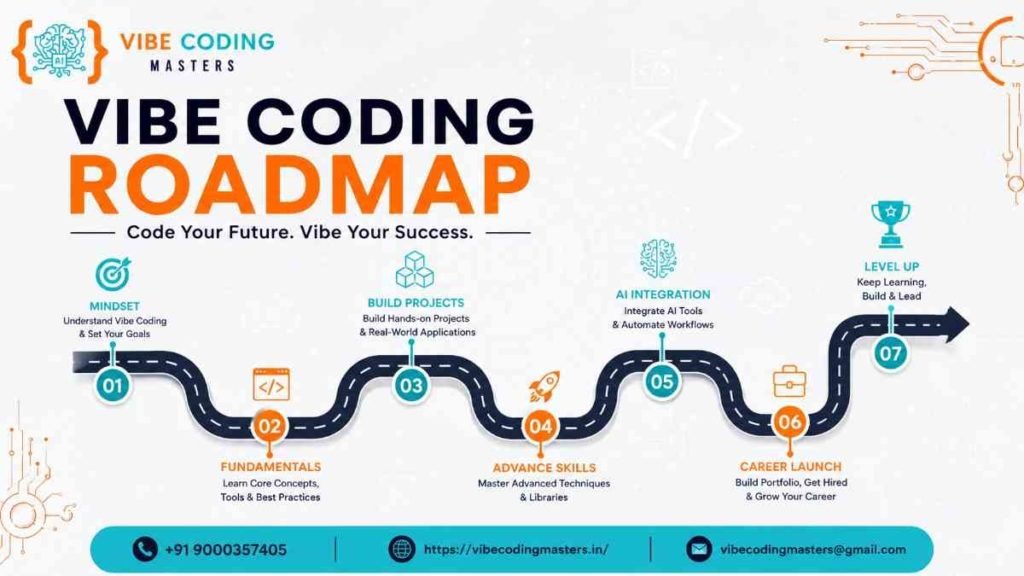
Version control with Git and GitHub is non-negotiable, and matters more in AI-assisted work because you generate large diffs fast and need to roll back cleanly. Add Docker, cloud deployment, AI-assisted debugging and a working grasp of software architecture. Our complete vibe coding roadmap sequences these in a learnable order rather than dumping them all at once.
Career Roadmap for Becoming a Vibe Coding App Developer
| Stage | Skills to Learn | Outcome |
| Beginner (Month 1–2) | HTML, CSS, JavaScript basics, Git fundamentals, prompt writing, one AI assistant | Can build and deploy a static site with AI help and read the generated code confidently |
| Intermediate (Month 3–5) | React, TypeScript, REST APIs, SQL, Node.js or Python backend, authentication | Ships a complete full-stack CRUD application with login and a real database |
| Advanced (Month 6–9) | Next.js, cloud deployment, Docker, testing, performance profiling, security basics | Runs a production-grade application with CI, tests and monitoring; job-ready portfolio |
| Expert (Month 10–18) | System design, AI integration, agentic workflows, code review at scale, mentoring | Leads AI-assisted delivery for a team; senior or architect-track compensation |
The timelines assume consistent part-time study alongside a job; full-time learners typically compress this by around 40%.
Certifications That Improve Your Vibe Coding Career
Certifications will not get you hired alone, but they filter you past HR screens and structure self-study. The ones worth your time are AI fundamentals credentials, Microsoft AI certifications, Google AI certifications, GitHub certifications, AWS cloud certifications, Azure Fundamentals, dedicated prompt engineering courses, and full stack development certifications.
My advice is consistent: pair one cloud certification with one AI certification and spend the rest of your time building. Recruiters spend seconds on your certificate list and minutes on your GitHub. We cover which credentials carry weight with Indian employers in our guide to vibe coding certification.
Future Scope of Vibe Coding App Development
Several trends converge in the same direction.
AI-first software development is becoming the default assumption in new projects rather than an optional accelerator. Autonomous coding is advancing, though reality is more measured than the marketing: 52% of developers either avoid agents or stick to simpler assistants, and 38% have no near-term plans to adopt them. AI software engineering is professionalising, with review standards, testing expectations and security practices catching up to adoption.
Enterprise AI adoption in India is accelerating faster than the workforce can be reskilled, and that imbalance is the strongest argument for learning this now. The startup ecosystem benefits disproportionately, since a two-person team can build what previously needed six. And the future job market treats AI fluency the way it treated version control a decade ago: assumed, not celebrated.
How to Start Learning Vibe Coding App Development
- Programming basics. Work through the Beginner row of the roadmap above before touching anything else. Every person I have seen fail at vibe coding failed here first.
- AI coding tools. Pick one conversational assistant and one IDE-integrated tool. Learn their context limits and where they reliably fail.
- Building projects. Start with a to-do app, then a blog with authentication, then something with a payment flow. Our list of vibe coding projects for beginners gives you a graded sequence.
- Version control. Commit daily. Learn branching, merging and reverting properly.
- Deployment. Put every project on the public internet. An undeployed project does not count in an interview.
- Portfolio creation. Three deployed applications with clean READMEs beat twelve tutorial clones. A full stack vibe coding project makes a strong centrepiece.
- Freelancing. Take small paid work early; client constraints teach what tutorials cannot.
- Job preparation. Practise explaining your architectural decisions out loud, including the ones you overrode.
Why Vibe Coding App Development is One of the Best Tech Careers
High salary potential is the obvious draw, but the durable arguments are structural. Demand is growing faster than skilled supply, which keeps negotiating power on the candidate's side. The learning curve is faster than traditional development, because AI removes much of the syntax memorisation that used to gate beginners.
The deeper argument is durability. Every previous automation wave devalued the people who only executed and rewarded the people who could direct the work, and this one is no different. That is why the skill is worth learning properly rather than superficially. If you want a structured path into it, the best Vibe Coding Course In Hyderabad option is the one that makes you build, not the one that makes you watch.
Comparison Tables
Vibe Coding App Development vs Traditional App Development
| Factor | Vibe Coding App Development | Traditional App Development |
| Speed to prototype | Hours to days | Days to weeks |
| Primary skill | Intent specification and code review | Syntax fluency and manual implementation |
| Boilerplate effort | Largely automated | Written by hand |
| Debugging burden | Higher on unfamiliar generated code | Lower, since you wrote it |
| Team size needed | Smaller | Larger |
| Best suited for | MVPs, internal tools, rapid iteration | Highly regulated or performance-critical systems |
Vibe Coding vs Low-Code Development
| Factor | Vibe Coding | Low-Code |
| Output | Real source code you own | Platform-managed components |
| Customisation ceiling | Effectively unlimited | Limited by platform features |
| Vendor lock-in | Low | High |
| Skill required | Programming fundamentals | Platform-specific knowledge |
| Ideal user | Developers | Technical business users |
Vibe Coding vs No-Code Platforms
| Factor | Vibe Coding | No-Code |
| Coding knowledge needed | Yes, for review and correction | None |
| Complexity supported | Production applications | Simple workflows and sites |
| Scalability | Scales with proper architecture | Hits platform ceilings quickly |
| Cost at scale | Infrastructure cost only | Rising per-user subscription cost |
| Career value | Transferable engineering skill | Tool-specific skill |
AI-Assisted Development vs Manual Coding
| Factor | AI-Assisted Development | Manual Coding |
| Consistency of style | High if conventions are given | Depends on discipline |
| Test coverage | Easier to achieve | Often deprioritised |
| Author's grasp of the code | Partial until reviewed line by line | Complete by construction |
| Code review burden | Shifts to the reviewer | Shared with the author |
| Learning effect | Weaker if used passively | Stronger by default |
Industry Statistics and Market Trends
The adoption and productivity figures quoted earlier describe how developers work. The figures below describe the market they work in, and they are the ones worth quoting in an interview.
On market size, India's AI software and services market is projected to grow at a 25–35% CAGR and approach USD 17 billion by 2027, according to NASSCOM's industry analysis.
On talent supply, the Indian AI talent pool is expected to rise from roughly 600,000–650,000 professionals to more than 1.25 million between 2022 and 2027, while AI-related job demand crosses one million roles. The gap between those two lines is the opportunity.
On hiring signals, roughly 11.7% of Indian job postings now explicitly require AI skills, up from 8.2% a year earlier, and LinkedIn recorded close to 100% year-on-year growth in India's prompt-engineering talent pool.
On language trends, Python usage among developers rose seven percentage points in a single year, the largest move of any major language, driven almost entirely by AI work.
Key Takeaways
- Vibe coding app development means building software by describing intent in natural language while AI generates the implementation, with the developer reviewing and correcting the output.
- Programming fundamentals are more important in this workflow, not less, because reading and debugging generated code is now the majority of the job.
- Salaries in India range from ₹5–8 LPA for freshers to ₹30–50 LPA for leads and architects, with company type and portfolio quality driving most of the variation.
- Adoption is already mainstream rather than experimental, and Indian demand for these skills is running well ahead of the trained talent supply.
- The fastest path to employability is three deployed, well-documented applications rather than a long list of certificates.
Conclusion
Vibe coding app development is not a passing trend. It is a change in how software gets specified, written and reviewed, and it has already moved from experiment to default across large parts of the Indian technology industry. The developers who benefit most are not the ones who type prompts fastest, but the ones who understand systems well enough to know when the AI is wrong.
The career case is straightforward. Demand exceeds skilled supply by a wide margin, compensation reflects that, and skill transfers across industries and geographies rather than locking you into one employer's stack.
What I tell every student is simple: stop researching and start building. Pick one AI assistant and one small application idea, and ship it publicly this month. Then do it twice more with increasing complexity. That portfolio will do more for your career than any amount of theory. If you want structure, feedback and project mentorship while you do it, our Vibe Coding Course In Hyderabad classes are designed exactly for that, and you are welcome to sit in on a demo session before deciding.
FAQ
1. What is vibe coding app development?
Vibe coding app development is the process of building applications by describing requirements in natural language while AI generates the underlying code. Developers provide instructions, review the generated code, fix errors, optimize performance, and integrate features into a complete application. It combines AI-assisted coding with real software engineering skills.
2. Do I need programming knowledge for vibe coding app development?
Yes. While AI can generate code from prompts, programming knowledge is essential for debugging, securing, testing, and scaling applications. Professional developers must understand how the generated code works because AI can sometimes produce incorrect or inefficient solutions.
3. How long does it take to learn vibe coding app development?
Most learners become job-ready within 6–9 months of consistent part-time learning or 4–5 months of full-time study. The fastest progress comes from building real-world projects, deploying applications, and practicing AI-assisted development rather than only watching tutorials.
4. What is the salary of a vibe coding app developer in India?
Typical salary ranges in India are:
- Freshers: ₹5–8 LPA
- Mid-Level (3–5 years): ₹10–15 LPA
- Senior Developers: ₹18–30 LPA
- Lead/Architect Roles: ₹30–50 LPA (especially in product companies and Global Capability Centers)
Actual salaries vary based on skills, company, location, and project experience.
5. Which AI tools are best for vibe coding app development?
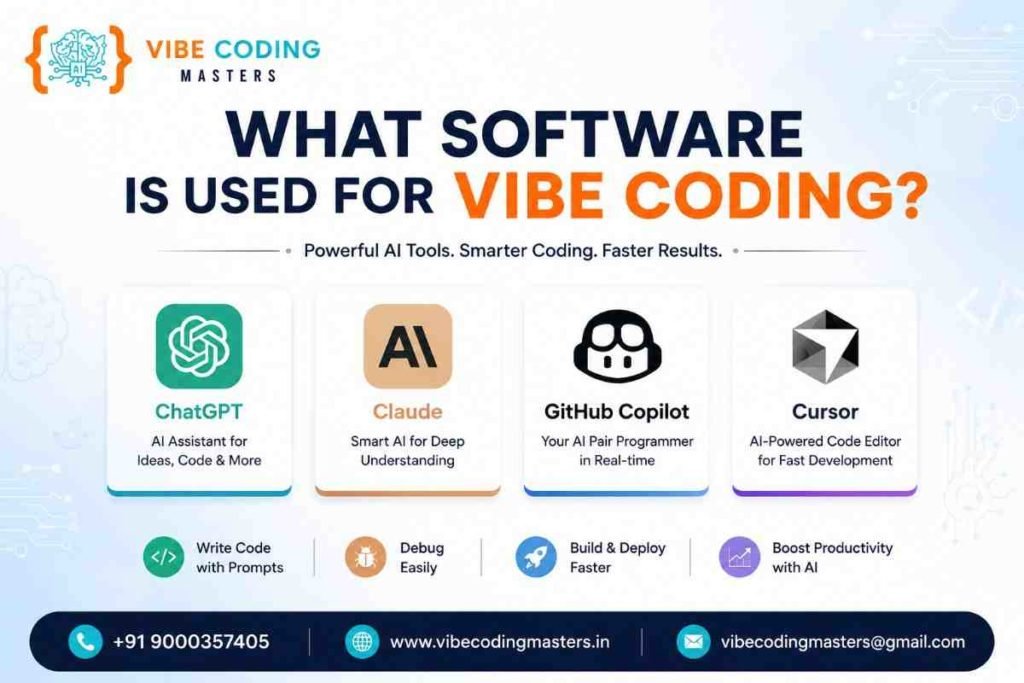
Professional developers often use multiple AI tools together, including:
- ChatGPT for architecture, debugging, and code explanations
- GitHub Copilot for AI-powered coding inside the IDE
- Cursor AI for context-aware code generation
- Claude for long-form code analysis
- Lovable, Bolt, or similar AI app builders for rapid prototyping
Using two or three complementary tools usually delivers better results than relying on a single AI assistant.
6. Is vibe coding app development a good career in 2026?
Yes. AI-assisted software development is becoming a core skill across the IT industry. Companies are actively hiring developers who can combine programming expertise with AI tools, making vibe coding app development one of the fastest-growing technology career paths in 2026.
7. What is the difference between vibe coding and no-code development?
Vibe coding generates real source code that developers can modify, extend, and deploy independently. It requires programming knowledge and supports enterprise-scale applications.
No-code platforms allow users to build applications without coding but are generally limited by platform capabilities, customization options, and vendor dependency.
8. Can I build a production-ready application entirely with vibe coding?
Yes, AI can generate most of the application, but human oversight remains essential. Developers must review the code for security, scalability, performance, testing, database design, and edge cases before deploying a production application.
9. What skills should I learn first for vibe coding app development?
A recommended learning roadmap is:
- HTML & CSS
- JavaScript
- Git & GitHub
- React
- Node.js or Python
- SQL & Database Design
- REST APIs
- Prompt Engineering
- Testing and Deployment
Prompt engineering should complement programming skills—not replace them.
10. Does vibe coding replace software developers?
No. Vibe coding changes the way developers work rather than replacing them. AI automates repetitive coding tasks, allowing developers to focus on architecture, system design, code reviews, debugging, optimization, and solving complex business problems. Developers who effectively use AI tools are expected to remain highly valuable in the software industry.
Vibe Coding Trainer
Vibe Coding Trainings Editorial Team | 39 articles published
Vibe Coding Trainings Editorial Team shares expert insights on AI-powered development, coding tools, and software careers. Helping developers learn faster and build smarter.
We provide all types of courses related to Front End, Back End, React, Angular, MERN, Python, and Java.
Quick Links
- Home
- Blogs
- Contact us
- Privacy Policy
- Terms and Conditions
- Refund Policy
Courses
- Frontend Vibe Coding
- Backend Foundations
- Advanced Vibecoding
- Full stack Basics
Contact with us
- JNTU Branch
- Metro Pillar No: A690, Metro Station, 3rd Floor, Dr Atmaram Estates, beside Landmark Hospital, Near JNTU, Hyder Nagar, Vasantha Nagar, Hyderabad, Telangana 500072
- +91 9000357405
- vibecodingmasters@gmail.com
Vibe Coding Masters – A Subsidary of Brolly Academy © 2026 | Designed with ♥ in Hyderabad By Brolly.Group
Project content
Vibe Coding Masters
Created by you
Add PDFs, documents, or other text to reference in this project.
Hyderabad, Telangana,
Hyderabad, India, 500072