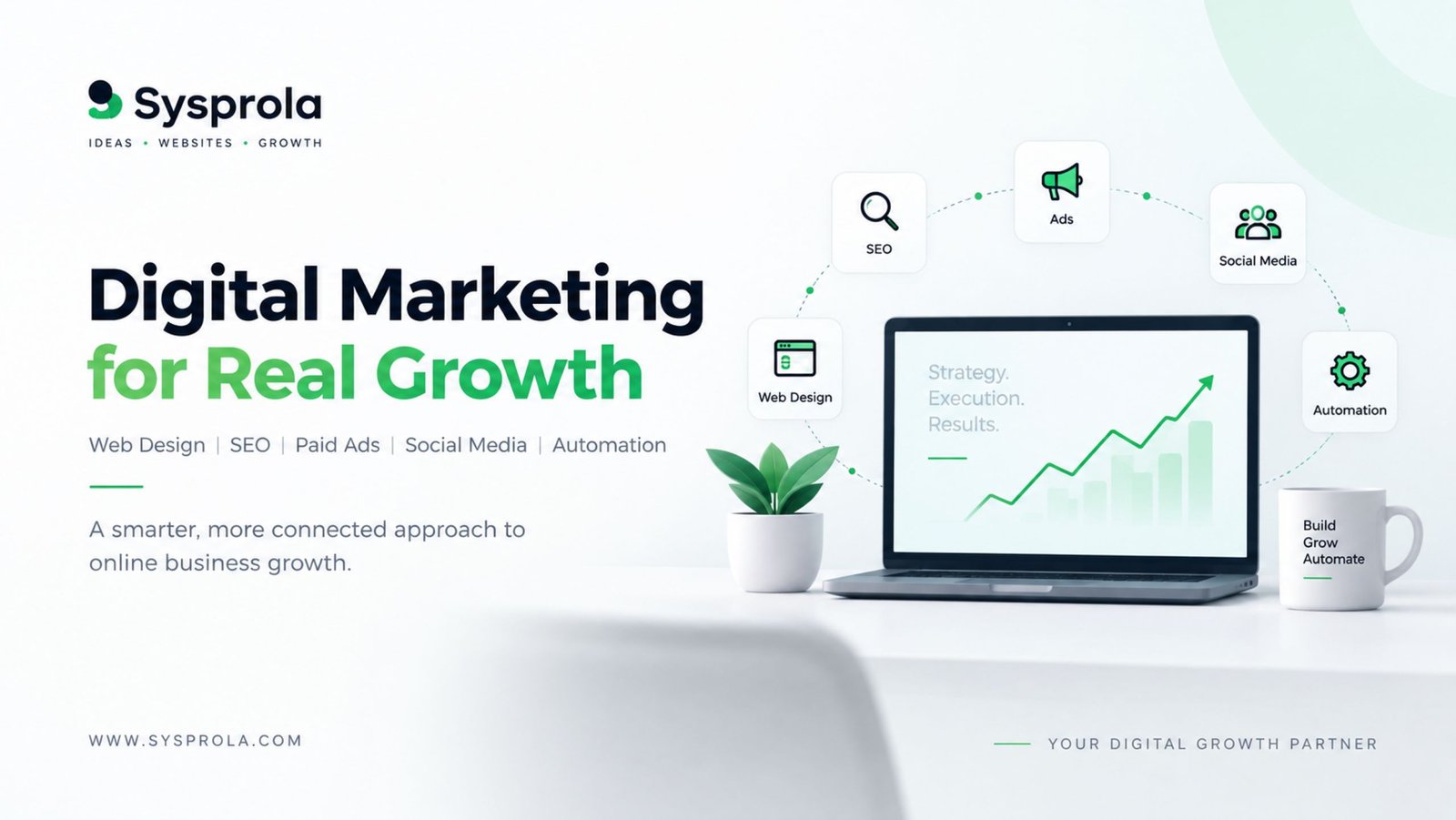
Digital marketing has become an important part of how modern businesses attract customers, build visibility, and generate revenue. However, having multiple digital channels does not automatically create a successful marketing strategy. A business may have a website, social media accounts, paid campaigns, and email marketing, yet still struggle to turn online activity into meaningful results.
The difference often comes down to how these channels work together.
Sysprola digital marketing takes an integrated approach by combining digital marketing with web design, development, and automation. Instead of treating a website, SEO campaign, advertising, and customer management as completely separate activities, businesses can build a more connected digital ecosystem.
Why Digital Marketing Needs a Broader Strategy
Digital marketing is no longer limited to publishing blog posts or running advertisements. Customers can discover a business through search engines, social media, paid advertisements, local listings, recommendations, and other online channels.
Each interaction contributes to the overall customer journey.
For example, a potential customer may first discover a company through Google. They might then visit the website, compare services, read reviews, follow the company's social media profile, and eventually submit a contact form. If these different touchpoints provide inconsistent information or create unnecessary friction, the business may lose the lead.
A well-planned digital strategy considers this entire journey.
This is where services such as SEO, paid advertising, content, web development, social media marketing, and automation can complement one another.
The Role of a Strong Website
A company's website remains one of its most important digital assets. Advertising and social media can bring visitors, but the website is often where users decide whether to take the next step.
A good business website should communicate the company's value proposition quickly, provide useful information, work well on mobile devices, and make important actions easy to complete.
Website performance also matters. Slow-loading pages, confusing navigation, poor mobile experiences, broken links, and unclear calls to action can affect both user experience and conversions.
This makes web development an important part of digital marketing rather than something that should be considered separately.
Businesses exploring a combination of web design, marketing, and automation services from Sysprola can use an integrated approach to improve both their online presence and the systems supporting it.
SEO and Long-Term Visibility
Search engine optimization remains an important source of sustainable website traffic. Unlike paid advertising, where traffic generally depends on an ongoing advertising budget, organic search can continue generating visitors after a page has established visibility.
However, effective SEO requires more than adding keywords to pages.
Modern SEO involves understanding search intent, creating useful content, improving technical website foundations, developing internal links, optimizing important landing pages, and establishing topical relevance.
For a local business, the strategy can also include local search optimization, business listings, location-focused content, and reputation signals.
The goal is not simply to rank for a large number of keywords. The objective is to attract people whose searches are relevant to the products or services the business actually provides.
Paid Advertising for Immediate Reach
SEO can be valuable for long-term visibility, but businesses sometimes need a faster way to reach potential customers. Paid advertising can help provide that additional reach.
Google Ads, Meta Ads, and other advertising platforms allow businesses to target specific audiences, locations, interests, search terms, and stages of the buying journey.
However, successful advertising is not simply about increasing ad spend.
The landing page, offer, messaging, targeting, tracking, and follow-up process all influence the final result. A campaign can generate a large number of clicks without producing enough qualified leads if the rest of the conversion process is poorly designed.
This is why paid advertising works best when it is connected to the website and broader marketing strategy.
Social Media as a Brand Touchpoint
Social media provides another way for businesses to maintain visibility and communicate with their audience.
Depending on the industry, platforms such as Facebook, Instagram, LinkedIn, and other social networks can support brand awareness, community building, product discovery, and customer communication.
The most useful social media strategies generally go beyond posting promotional messages repeatedly. Educational content, industry insights, customer stories, behind-the-scenes material, visual content, and useful information can help establish a more recognizable brand presence.
Social media can also support other marketing channels. For example, content created for a blog can be repurposed into social posts, short videos, graphics, or email content.
Automation Can Improve the Customer Journey
One of the more important developments in digital marketing is the growing use of automation.
Marketing automation can reduce repetitive manual tasks and help businesses respond to leads more efficiently. Contact forms, CRM systems, email sequences, lead notifications, appointment workflows, and follow-up processes can be connected to create a smoother customer journey.
Consider a simple example.
A visitor submits a form requesting information about a service. Instead of leaving the lead in a spreadsheet, an automated system can record the enquiry, notify the relevant team member, send an acknowledgement email, and trigger an appropriate follow-up workflow.
Automation does not replace human interaction. Instead, it can help teams spend less time managing repetitive administrative work and more time handling qualified opportunities.
Connecting Marketing With Business Goals
A common problem with digital marketing is measuring activity instead of outcomes.
Businesses may track impressions, clicks, followers, page views, and website traffic. These metrics can provide useful information, but they do not necessarily explain whether marketing is contributing to business growth.
A stronger measurement framework connects marketing activity with meaningful business outcomes.
Depending on the business model, this could include:
- Qualified leads
- Form submissions
- Phone calls
- Bookings
- Ecommerce transactions
- Cost per acquisition
- Conversion rate
- Customer acquisition cost
- Return on advertising spend
- Organic revenue
This allows businesses to identify which channels are contributing to actual commercial objectives.
An Integrated Digital Ecosystem
The biggest opportunity comes when different digital services are designed to work together.
SEO can attract organic visitors.
Paid advertising can generate immediate targeted traffic.
Social media can strengthen brand visibility.
A well-designed website can convert visitors into enquiries or customers.
CRM and automation can organize and nurture those leads.
Analytics can provide feedback about what is working and where improvements are required.
Rather than viewing these as isolated services, businesses can treat them as interconnected parts of one digital ecosystem.
This approach can be particularly useful for growing businesses that have outgrown a basic website but are not yet ready to manage several specialized agencies or disconnected systems.
Choosing the Right Digital Marketing Partner
Selecting a digital marketing agency should involve more than comparing service lists.
Businesses should consider whether an agency understands their industry, target audience, customer journey, and commercial objectives. Communication, reporting, technical capabilities, and the ability to adapt strategies are also important factors.
A useful digital marketing partner should be able to explain not only what work is being performed but also why it matters.
For example, instead of simply recommending a new landing page, the agency should be able to explain what problem the page addresses, which audience it targets, how it fits into the conversion journey, and how its performance will be measured.
That strategic connection is what can turn individual marketing activities into a coherent growth system.
Final Thoughts
Digital marketing is increasingly becoming a combination of technology, content, data, user experience, and automation. Businesses that treat these areas independently can miss opportunities to connect the customer journey.
An integrated approach can help create a stronger relationship between visibility, engagement, conversion, and follow-up.
For companies looking to combine website development, marketing, and automation, Sysprola provides a range of digital services designed around these areas.
Ultimately, effective digital marketing is not about being present on every platform. It is about building the right digital infrastructure, reaching the right audience, providing useful experiences, and creating systems that turn attention into measurable business opportunities.