


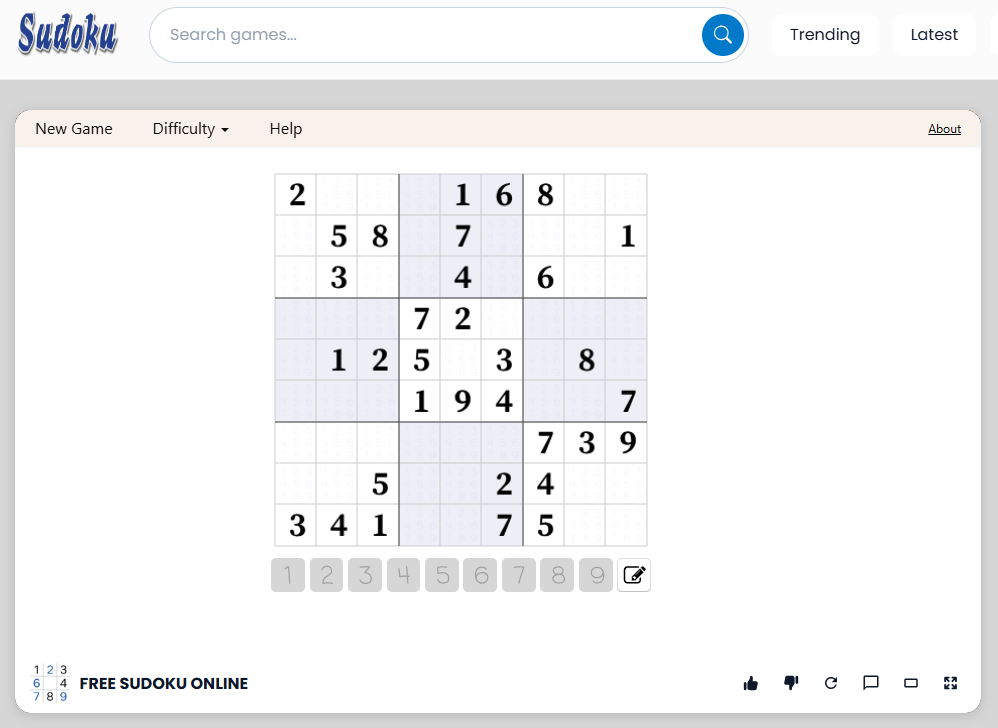
Sudoku is one of the most popular logic puzzle games in the world. Simple rules make the game easy to understand, while increasingly difficult puzzles create a strong challenge for beginners and experienced players. Sudoku does not require advanced mathematics or special knowledge. Instead, the game depends on logical thinking, careful observation, memory, and patience.
A standard Sudoku puzzle uses a 9x9 grid divided into nine smaller 3x3 boxes. The main goal is to fill every empty cell with numbers from 1 to 9. Each number can appear only once in every row, column, and 3x3 box. These simple rules create a wide range of possible puzzles and make every game a unique mental challenge.
What Is Sudoku?
Sudoku is a number placement puzzle based on logical deduction. Although numbers are used, mathematical calculations are not normally required. Players study the existing numbers and determine which values can logically fit into each empty position.
Understanding the Sudoku Grid
A traditional Sudoku board contains 81 cells arranged in nine rows and nine columns. The board is also divided into nine 3x3 boxes. Some cells already contain numbers called clues, while the remaining cells must be completed by the player.
Every row must contain the numbers 1 through 9 without repetition. The same rule applies to every column and every 3x3 box. A completed puzzle therefore contains nine occurrences of every number across the entire grid.
The Basic Rules of Sudoku
The rules are straightforward. A number from 1 to 9 must be placed in every empty cell. However, the chosen number cannot already exist in the same row, column, or 3x3 box.
For example, if a row already contains the numbers 1, 2, 4, 6, 7, and 9, the missing values must come from 3, 5, and 8. The column and box must then be checked before placing any number. This process gradually reduces the available choices until the correct solution becomes clear.
Why Sudoku Is Popular Around the World
Sudoku has remained popular because the game combines simplicity with depth. A player can learn the basic rules within minutes but may spend much longer developing advanced solving techniques.
Sudoku Provides a Mental Challenge
Solving Sudoku requires continuous attention. Players need to compare rows, columns, and boxes while remembering possible candidates for empty cells. This process creates an engaging mental workout that can be enjoyed during a short break or during a longer puzzle session.
The difficulty can also be adjusted. Easy puzzles provide a comfortable introduction, while medium and hard puzzles require more careful deduction. Expert puzzles can demand several advanced techniques before a solution becomes possible.
Sudoku Fits Different Playing Styles
Sudoku can be played on paper, through mobile applications, on computers, or through online puzzle platforms. Players can choose a quick puzzle during a short break or spend more time solving a complex grid.
The game also does not depend on language ability. Since the main elements are numbers and logical relationships, Sudoku can be enjoyed by people from many different backgrounds.
How to Solve Sudoku More Effectively
A good Sudoku strategy begins with simple deductions. Trying to guess numbers randomly can create unnecessary mistakes and make the puzzle harder to understand.
Start With Easy Opportunities
Look for rows, columns, or boxes that already contain many numbers. These areas usually have fewer missing values, making them easier to solve.
Another useful method is to search for a number that has very few possible positions inside a particular 3x3 box. If only one cell can legally contain that number, the placement is certain.
Use Candidate Numbers
When a cell cannot be solved immediately, note the possible numbers that can fit there. These possibilities are called candidates. As more numbers are placed elsewhere, some candidates can be eliminated.
Candidate notation is especially useful for medium and difficult puzzles. It helps organize information and prevents repeated guessing.
Learn Advanced Solving Techniques
More difficult Sudoku puzzles can require techniques such as naked pairs, hidden pairs, pointing pairs, and box-line interactions. These methods help identify relationships between candidate numbers and eliminate incorrect possibilities.
Advanced techniques may seem complicated at first, but regular practice makes them easier to recognize. Learning one technique at a time can gradually improve solving speed and accuracy.
Benefits of Playing Sudoku
Sudoku is mainly an entertainment activity, but it also encourages several useful cognitive habits. The game requires concentration, structured thinking, and careful decision-making.
Improved Concentration and Attention
A Sudoku grid contains many connected pieces of information. One number placed in a single cell can affect the possibilities in several nearby cells. Players therefore need to maintain attention throughout the solving process.
Regular puzzle practice can encourage a more organized approach to complex information. The player learns to examine details instead of making decisions based only on instinct.
Logical Thinking and Problem Solving
Sudoku rewards deduction rather than random guessing. Each correct placement should have a logical reason. This makes the game an excellent example of constraint-based problem solving.
Players gradually learn to identify patterns, compare possibilities, eliminate contradictions, and make decisions based on available evidence.
Tips for Beginners
New players should avoid starting with the hardest available puzzle. Easy Sudoku puzzles provide a better environment for learning the rules and developing confidence.
Begin by scanning the entire grid for rows, columns, and boxes with many completed cells. Fill obvious numbers first, then move toward areas with fewer possibilities. If a solution is not immediately visible, use candidate numbers rather than guessing.
It is also important to remain patient. A difficult puzzle may require several minutes of careful examination before the next move becomes obvious. Every solved cell can provide new information for the rest of the grid.
Choosing the Right Sudoku Difficulty
Sudoku difficulty can vary considerably. Easy puzzles generally contain more direct deductions and are suitable for beginners. Medium puzzles introduce more complex relationships between cells. Hard and expert puzzles require stronger logical techniques and greater concentration.
Choosing an appropriate difficulty level keeps the game challenging without making it frustrating. As solving ability improves, players can gradually move toward more demanding puzzles.
Conclusion
Sudoku is a timeless logic puzzle that combines simple rules with endless intellectual challenges. The 9x9 grid is easy to understand, yet every puzzle can require a different approach. Through logical deduction, candidate elimination, pattern recognition, and patience, players can gradually complete even difficult grids.
Whether played for relaxation, entertainment, or mental stimulation, Sudoku offers an accessible challenge for many types of players. With regular practice and a clear solving strategy, beginners can develop stronger puzzle-solving skills while experienced players can continue discovering more advanced techniques. Sudoku remains popular because every new grid presents a fresh opportunity to think, analyze, and solve.