


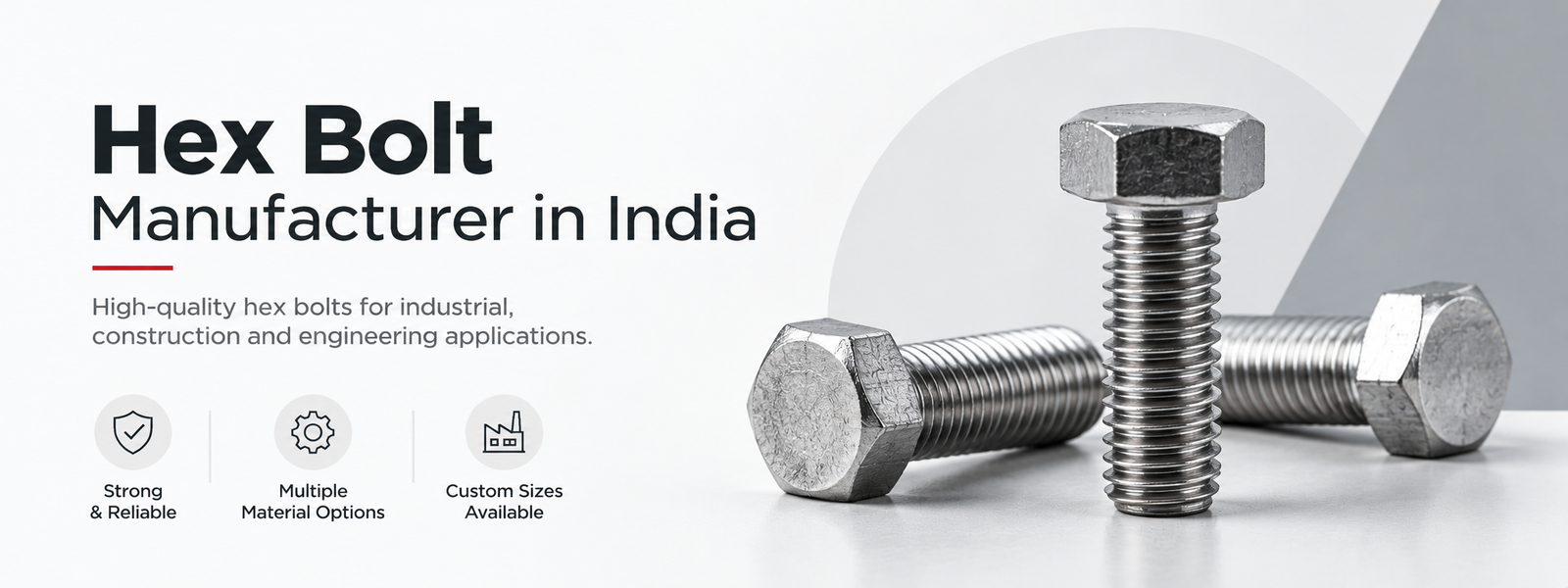
Hex bolts are among the most widely used fasteners in industrial manufacturing, construction, machinery, fabrication, and engineering projects. Their six-sided heads allow easy tightening and removal with standard tools, making them suitable for a wide range of mechanical fastening applications.
Choosing the right hex bolt manufacturer in India is essential for businesses that require consistent dimensions, suitable material grades, reliable finishes, and fasteners that meet specific engineering requirements.
India's fastener manufacturing industry serves equipment manufacturers, construction companies, engineering contractors, industrial distributors, and international buyers. Understanding hex bolt types, material options, and technical specifications helps procurement teams select the right products for their applications.
What Is a Hex Bolt?
A hex bolt is a threaded fastener featuring a six-sided head designed to be tightened or loosened using a spanner or socket. It is commonly used with a compatible nut or threaded hole to secure two or more components.
Hex bolts are available in different diameters, lengths, thread configurations, material grades, and surface finishes. Their suitability depends on the joint design, expected loads, installation conditions, and applicable engineering standards.
Businesses looking for a reliable hex bolt manufacturer in India should evaluate these specifications before placing an order, particularly when sourcing fasteners for industrial or heavy-duty applications.
Types of Hex Bolts Available in India
Different fastening requirements call for different bolt configurations. Understanding the available types helps buyers choose products that fit their assemblies and operating conditions.
1. Full Thread Hex Bolts
Full thread hex bolts have threads extending along the entire shank, subject to the specified dimensions and standard.
They are commonly used in applications where the threaded portion needs to engage with a nut or threaded component along most of the bolt's length.
Typical applications include:
- General industrial assembly
- Equipment installation
- Maintenance and repair work
- Fabrication projects
- Mechanical fastening applications
The thread size, pitch, length, and material grade should be specified according to the intended joint.
2. Half Thread Hex Bolts
Half thread hex bolts feature a partially threaded shank, leaving an unthreaded section beneath the head.
This configuration may be preferred when the joint design requires the unthreaded shank to pass through the connected components or occupy a specified shear plane.
Common applications include machinery assembly, structural fabrication, and selected heavy-duty fastening arrangements.
The required thread length and shank diameter should be confirmed against the engineering drawing.
3. High-Tensile Hex Bolts
High-tensile hex bolts are manufactured to specified mechanical property requirements for applications that demand defined strength characteristics.
Property class 10.9 is one example used in industrial fastening. Its suitability depends on the joint design, mating components, installation procedure, and applicable standard.
Buyers should specify the required property class rather than relying on general descriptions such as heavy-duty or high-strength.
4. Stainless Steel Hex Bolts
Stainless steel hex bolts are commonly selected where corrosion resistance is an important consideration.
They are used in machinery, outdoor equipment, marine-related applications, fabrication, and industrial environments where the material must withstand particular exposure conditions.
Common stainless steel options include grades 304 and 316, subject to availability and application requirements.
The appropriate grade should be selected based on the environment, mechanical requirements, and compatibility with the connected materials.
5. Mild Steel Hex Bolts
Mild steel hex bolts are widely used in general engineering, fabrication, machinery, and construction applications.
They offer a practical fastening solution where the specified mechanical properties and environmental conditions are compatible with the material.
Depending on the application, surface finishes such as galvanising or zinc plating may be considered to provide additional corrosion protection.
6. Custom and Special Hex Bolts
Certain projects require non-standard dimensions, thread configurations, head designs, or material specifications.
Custom hex bolts can be considered for OEM manufacturing, replacement parts, specialised machinery, and engineering projects where standard catalogue products do not meet the required dimensions.
Manufacturing feasibility depends on the drawing, material, quantity, tolerances, and required production process.
Materials Used in Hex Bolt Manufacturing
Material selection affects a bolt's mechanical properties, corrosion resistance, durability, and suitability for the working environment.
Stainless Steel
Stainless steel is frequently considered for applications where corrosion resistance is important.
- SS 304: Often used in general industrial environments with moderate corrosion exposure.
- SS 316: Commonly considered for marine and chloride-exposed environments, depending on the specific conditions.
The required grade should be confirmed before ordering. Stainless steel should not automatically be assumed suitable for every corrosive environment or high-load application.
Mild Steel
Mild steel is suitable for a wide range of general fastening requirements where the specified mechanical properties are sufficient.
It is commonly used in fabrication, equipment assembly, and industrial maintenance. The appropriate finish should be determined by the expected exposure to moisture, chemicals, and other environmental factors.
Carbon and Alloy Steel
Carbon and alloy steels are used for applications requiring specified mechanical properties and strength levels.
Depending on the product specification, manufacturing may involve controlled heat treatment and inspection to achieve the required mechanical characteristics.
For high-tensile bolts, buyers should confirm the property class, applicable standard, and documentation required for the project.
Industrial Applications of Hex Bolts
Hex bolts are used across numerous industries because of their practical design and compatibility with a wide range of fastening assemblies.
Construction and Infrastructure
Hex bolts are used in selected structural assemblies, fabricated components, equipment installation, and construction-related fastening applications.
The correct bolt grade, dimensions, and installation procedure must be established according to the relevant structural design.
Machinery and Equipment Manufacturing
Manufacturers use hex bolts to assemble machine frames, housings, brackets, mechanical components, and equipment supports.
Full-thread and half-thread configurations can be selected according to the joint design and required thread engagement.
Automotive and Transportation
Hex bolts are used in various vehicle assemblies, equipment mounts, and maintenance applications. Automotive components may require specific property classes, dimensional tolerances, coatings, and manufacturing standards.
Oil, Gas, and Process Industries
Industrial facilities may use hex bolts in equipment supports, fabricated assemblies, maintenance work, and other specified fastening applications.
Material compatibility, corrosion exposure, temperature, and applicable industry requirements should be considered during selection.
Power Plants and Heavy Engineering
Power generation facilities and heavy engineering projects require fasteners matched to the equipment design and service conditions.
The specified grade, thread, dimensions, finish, and inspection documentation should be confirmed before procurement.
Fabrication and General Manufacturing
Fabrication companies use hex bolts to assemble steel structures, machine components, brackets, frames, and customised industrial products.
Consistent dimensions and reliable supply are particularly important for repeat production and maintenance schedules.
How to Choose the Right Hex Bolt Manufacturer in India
Selecting a manufacturer involves more than comparing prices. Buyers should consider technical capability, product consistency, material specifications, and supply requirements.
1. Evaluate Manufacturing Capabilities
Confirm whether the manufacturer can supply the required bolt dimensions, thread configurations, head types, and production quantities.
If your project requires non-standard fasteners, ask whether technical drawings or samples can be reviewed for manufacturing feasibility.
2. Verify Material and Property Grades
The bolt's material and mechanical property class must match the application.
Ask for relevant material certificates, inspection reports, and traceability documentation where required. Do not assume that all products in a manufacturer's range share the same grade or certification.
3. Check Dimensional Accuracy
Thread pitch, diameter, overall length, head dimensions, and threaded length affect compatibility with the assembly.
For critical applications, establish the required tolerances and inspection criteria before placing an order.
4. Review Surface Finishes
Surface treatments may improve corrosion protection or meet specific project requirements.
Common options include:
- Plain or uncoated finishes
- Zinc plating
- Galvanising
- Specified stainless steel finishes
The selected finish should be compatible with the operating environment, dimensional requirements, and assembly design.
5. Confirm Applicable Standards
Industrial fasteners may be specified according to DIN, ISO, ASTM, or other relevant standards.
The exact standard and edition should be identified in the purchase specification. Product dimensions, mechanical properties, and testing requirements must be verified against the applicable standard rather than assumed from the product name alone.
6. Assess Customisation and Bulk Supply
For industrial buyers, the ability to handle repeat orders, bulk quantities, and drawing-based requirements can simplify procurement.
Confirm production feasibility, lead time, packaging, inspection documentation, and delivery arrangements before finalising the purchase.
Why Consider Lohar Forging for Hex Bolts?
Lohar Forging & Engg. Works is an Indian manufacturer of forged fasteners and industrial hardware based in Mumbai, Maharashtra. Its product range includes hex bolts, stud bolts, eye bolts, and other fastening components.
Businesses evaluating a hex bolt manufacturer in India can explore Lohar Forging's product information and discuss their requirements with the company.
Key considerations when enquiring include:
- Product configurations: Full-thread and half-thread hex bolts, along with selected square-head variants.
- Material options: Stainless steel and mild steel, subject to the required product specification.
- Size requirements: The published hex bolt range includes M6 to M200, with exact availability depending on configuration and specification.
- Property class: Grade 10.9 requirements are included in the published product range; confirm the exact size and grade before ordering.
- Surface finishes: Plain, galvanised, and natural stainless steel finishes are listed for the range, subject to product requirements.
- Custom manufacturing: Buyers can discuss non-standard requirements using drawings, samples, or detailed specifications.
- Industrial supply: Bulk and export enquiries can be discussed with the manufacturer.
Before placing an order, confirm the exact dimensions, material grade, thread specification, manufacturing standard, inspection requirements, availability, and delivery schedule.
Specifications to Provide When Ordering Hex Bolts
Providing complete technical information helps manufacturers assess requirements and prepare more accurate quotations.
| Specification | Details to Provide |
|---|---|
| Bolt type | Full-thread, half-thread, high-tensile, stainless steel, or custom |
| Diameter | Required nominal diameter, such as M10, M16, or M20 |
| Length | Overall length according to the applicable standard |
| Thread | Metric or other specified thread, including pitch where required |
| Material | Stainless steel, mild steel, carbon steel, or specified alloy |
| Property class | Required class or mechanical specification |
| Finish | Plain, galvanised, zinc-plated, or specified finish |
| Standard | DIN, ISO, ASTM, or project-specific standard |
| Quantity | Required number of pieces and expected repeat orders |
| Application | Machinery, construction, fabrication, or another use |
| Documentation | Material certificates, inspection reports, or test records as required |
| Delivery | Destination and required delivery schedule |
For custom or safety-critical requirements, attach the relevant engineering drawing and identify any dimensional tolerances or inspection criteria.
Frequently Asked Questions
What is a hex bolt used for?
A hex bolt is used to fasten two or more components together. It is commonly found in machinery, construction, fabrication, industrial equipment, and maintenance applications.
What is the difference between full-thread and half-thread hex bolts?
Full-thread hex bolts have threads along the entire specified shank length, while half-thread hex bolts include an unthreaded shank section. The appropriate type depends on the joint design, required thread engagement, and loading conditions.
Which material is best for hex bolts?
The best material depends on the application's mechanical requirements and environment. Stainless steel may be suitable where corrosion resistance is important, while mild steel or specified carbon and alloy steels may be appropriate for other applications.
What does Grade 10.9 mean for a hex bolt?
Property class 10.9 identifies a defined mechanical property class for applicable steel bolts. It is associated with a nominal tensile strength of 1,000 MPa and a nominal yield-strength ratio of 0.9. The required grade and conformity must be verified against the applicable standard.
Can hex bolts be manufactured to custom specifications?
Yes, custom hex bolts can be considered based on drawings or samples, depending on dimensions, material, quantity, manufacturing feasibility, and the required standard.
What sizes of hex bolts are available at Lohar Forging?
Lohar Forging's published product information lists a size range of M6 to M200. Actual availability depends on the bolt configuration, material, grade, and manufacturing requirements, so the exact specification should be confirmed with the manufacturer.
How do I select a reliable hex bolt manufacturer in India?
Review the manufacturer's product range, material options, dimensional inspection processes, ability to meet applicable standards, documentation, and capacity to fulfil your required quantities and delivery schedule.
What information should I provide for a hex bolt quotation?
Provide the bolt type, diameter, length, thread pitch, material, property class, finish, applicable standard, quantity, and delivery destination. A technical drawing is recommended for customised products.
Conclusion
Hex bolts are essential fastening components across construction, machinery, fabrication, transportation, and heavy engineering. Choosing the right product requires careful attention to dimensions, thread configuration, material, mechanical property class, surface finish, and operating conditions.
For industrial procurement teams, working with a manufacturer that understands technical specifications and custom requirements can simplify sourcing and support consistent product quality.
If you are looking for a hex bolt manufacturer in India, explore Lohar Forging's product range and share your specifications to discuss availability, customisation, and quotation requirements.